
Warehouse cleaning · 2144
Warehouse Cleaning Auburn
For the warehouse and light industrial units running out toward Silverwater and Clyde. Machine floor scrubbing, racking dust taken down top-first, docks kept clear, and the front office on the same schedule. Worked around your shifts, never through them.
- Scheduled around your pick and dispatch runs
- Machine scrubbing, not a mop pushing dust around
- Cleaners inducted on your site before the first shift
- SWMS, SDS and insurance certificates supplied up front
Paperwork before the first shift
Not after you chase us for it. Everything below is a document we can hand your landlord, your practice manager or your committee.
- $20m public liability
- Certificate of currency, emailed on request
- Police-checked cleaners
- WWCC-cleared where children are on site
- Nothing locking you in
- One fixed figure, in writing, inside 24 hours
What does warehouse cleaning in Auburn involve?
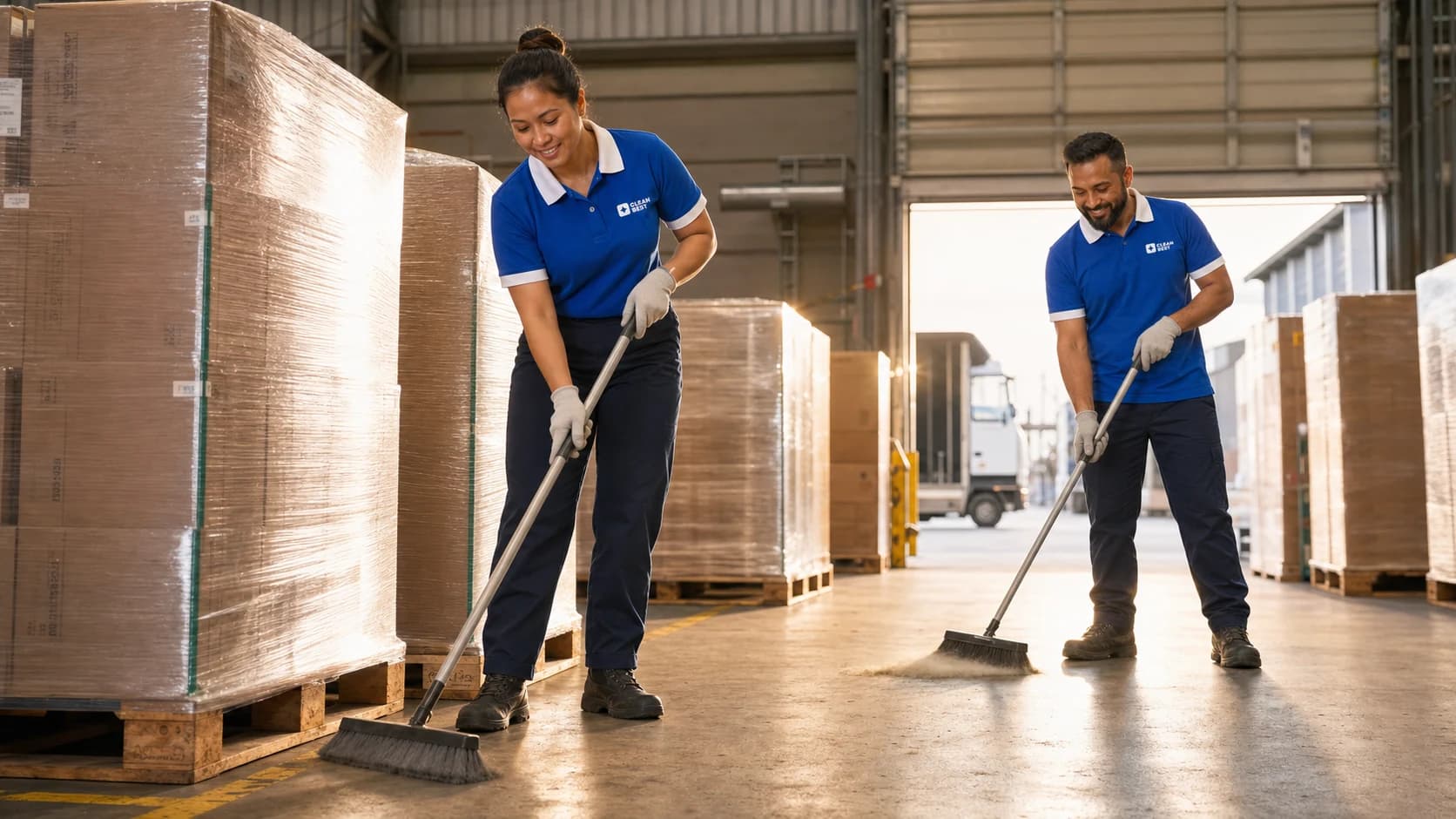
Warehouse cleaning in Auburn is the scheduled cleaning of warehouse and light industrial premises in the 2144 postcode and the industrial estates adjoining it toward Silverwater and Clyde. The core work is machine scrubbing of sealed concrete floors, removal of dust from racking and high-level surfaces, cleaning of loading docks and roller-door thresholds, and servicing of the front office and staff amenities.
The work is normally performed outside operating hours, because a cleaner and a scrubbing machine moving through an aisle during a forklift shift is a safety hazard. High-level dust is removed before the floor is cleaned, since the reverse sequence returns the dust to the floor.
Clean Best cleans warehouses in Auburn NSW 2144, carries $20m public liability cover, and inducts each cleaner on the specific site before their first shift. It supplies safe work method statements and safety data sheets on request, quotes after a free walkthrough, and works with no lock-in contract.
- Trading since 2015Family-operated, working out of Western Sydney
- Police-checked cleanersWWCC-cleared where children are on the premises
- $20m public liabilityCertificate of currency emailed on request
- Written quote in 24 hoursOne fixed figure, and nothing locking you in
The industrial end of Auburn
Warehouse cleaning Auburn operators can run a shift around
Warehouse cleaning Auburn operators actually need is a logistics problem before it is a cleaning problem. The units here — the light industrial and warehousing that runs out of Auburn toward Silverwater and Clyde, along Silverwater Road and the streets off it — are working buildings. They have a pick face, a dispatch cut-off, a truck arriving at a time somebody else decided, and a forklift that does not stop because a cleaner has arrived with a machine.
Get the scheduling wrong and it does not matter how good the clean is, because you will have created a safety incident to get it. So the first conversation is never about chemicals. It is about when the forklifts stop.
A mop on a warehouse floor is theatre
The floor in these units is sealed concrete, and the thing that dirties it is not really dirt — it is fine grey dust that settles continuously out of the air, tyre marks from pallet jacks and forklifts, and spills that have been driven over until they are part of the surface. A mop moves the dust from one part of the slab to another and leaves a grey film behind that dries slightly lighter than it went on. It looks like work. It is not.
Machine scrubbing lifts it, because the machine agitates the surface and then extracts the water rather than leaving it to dry. Where racking, stock or a tight aisle makes the machine impossible, that section gets done by hand — and we write that split into the scope explicitly, so nobody discovers in month three that the back aisles were never really in the price.
Dust comes down before the floor goes clean
The most common failure in warehouse cleaning is sequence. Racking collects dust on the upper beams, the uprights and every ledge, and it keeps releasing it. Clean the floor first and dust the racking afterwards and you have simply moved the dust from the beams onto the slab you just scrubbed — and, more expensively, onto the stock.
So it comes down top-first, on a rotation across the racking, and the floor is done last. Where the height genuinely needs equipment to reach safely, it is scoped and quoted as such. Nobody stands on a pallet. That is not a policy we are proud of, it is the baseline, and any contractor who agrees to do otherwise on your site is a liability you do not need.
The dock is where the mess gets in
Everything that dirties a warehouse arrives through the dock. The threshold, the roller-door tracks, the apron outside and the ground the trucks reverse over — if those stay dirty, the yard walks itself back into your aisles on the tyres of every pallet jack, all day, forever. It is the highest-leverage square metres on the site and it is almost always left out of a cheap scope.
We sweep and scrub the dock, keep the door tracks clear so the doors actually seal, and pressure wash the apron on a rotation. Bins and the ground around them are in scope too, because a bin area that has been allowed to go is a pest problem waiting to become your problem.
The front office and the lunch room
Almost every warehouse in Auburn has a front office and a lunch room, and your staff care about those far more than they care about the aisles. Nobody complains about a dusty beam at eight metres. Everybody complains about the microwave.
Both go on the same schedule, the same site register and the same invoice. It is more frequent than the warehouse floor — usually daily or near-daily on the amenities against a weekly or fortnightly machine scrub — and it means you are not managing a second contractor for the hundred square metres at the front of a building we already clean.
Induction, safety and the paperwork your officer will ask for
Your safety officer will want safe work method statements, safety data sheets for every product coming on site, evidence of the police check on each cleaner and a certificate of currency for the public liability cover. We send all of it before the first shift rather than after somebody chases us, and each cleaner is inducted on your site specifically: exclusion zones, forklift routes, emergency exits, and whatever hazard your operation carries that a generic induction would never mention.
What it costs to find out
A free walkthrough, at the hour we would really be working, looking at the concrete, the racking, the dock, the amenities and — most importantly — the traffic routes. A written scope within 24 hours setting out what is machine-scrubbed, what is done by hand, what rotates and when, with one fixed figure. No lock-in contract. And $20m public liability behind it.
Call 1300 494 983 and we will come and look at the unit.
Sequence and safety
Top-down, out-of-hours, and inducted before we arrive
The order of operations is not a detail, it is the job. High-level dust off the racking first, then the aisles, then the floor, then the dock. Reverse any part of that and you are cleaning the same slab twice and putting dust back on the stock. It is written into the schedule so the crew is not deciding it on the night.
And it happens when the site is still. We map your shift pattern at the walkthrough — when the last pick finishes, when the forklifts are parked, when the trucks stop — and we work inside that window. Each cleaner is inducted on your exclusion zones and traffic routes before their first shift, and the safe work method statements are in your safety officer's hands before we set foot on the slab.
- High-level dust removed before the floor is scrubbed
- Worked around your shifts, never through them
- Site-specific induction: exclusion zones, forklift routes, exits
- SWMS and safety data sheets supplied before the first shift
What's included
What a warehouse clean covers in Auburn
A typical scope for a working light industrial unit. Yours is written from the walkthrough — this is the shape it usually takes.
- Machine-scrub sealed concrete in all aisles and open floor the machine can reach
- Hand-clean the aisles and corners racking or stock makes unreachable by machine
- Remove dust from racking beams, uprights and ledges, top-down, on the agreed rotation
- Sweep and scrub the loading dock, the threshold and the roller-door tracks
- Clear and clean the bin area and the ground immediately around it
- Pressure wash the dock apron and hardstand on the agreed rotation
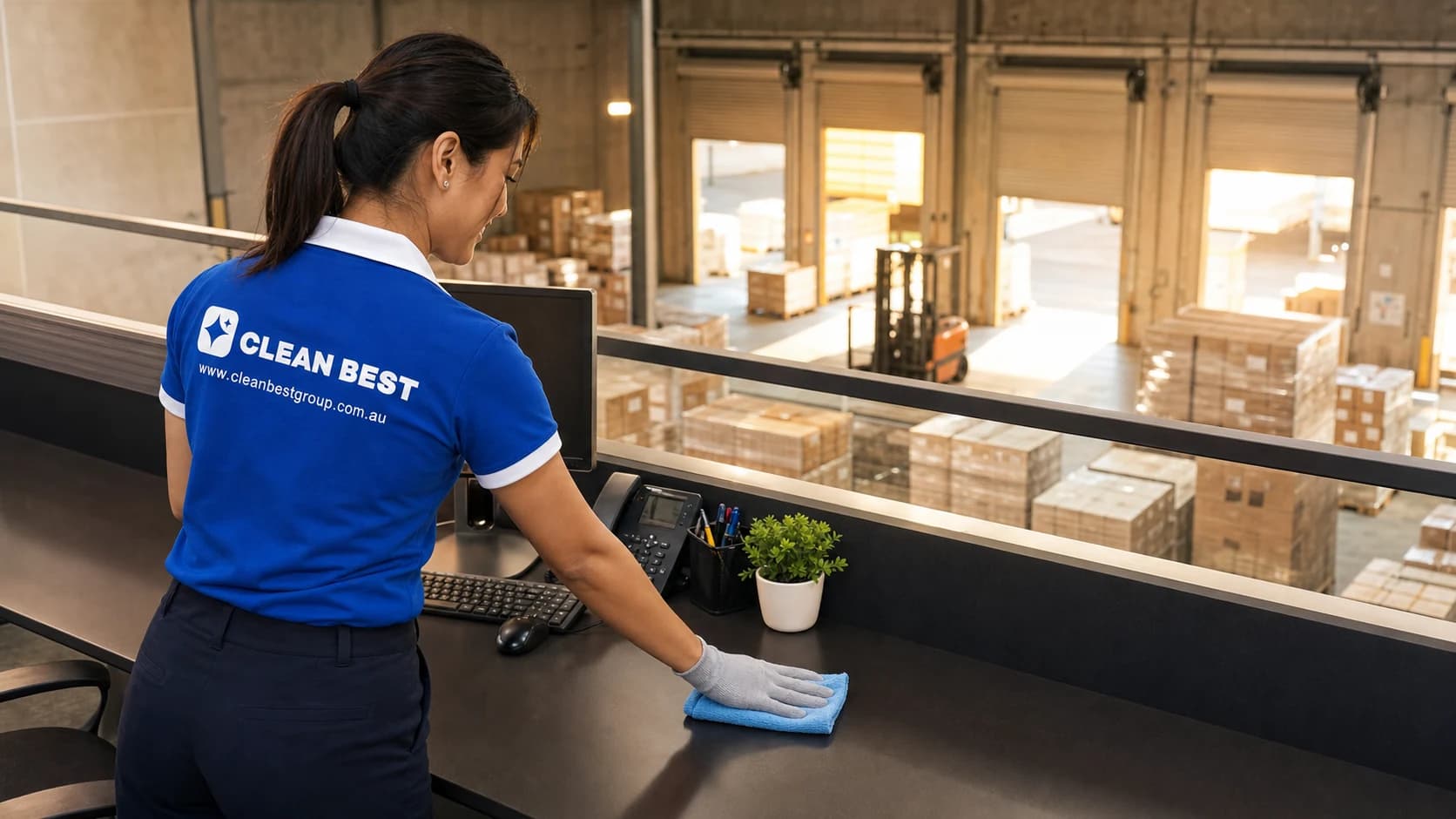
- Clean the front office — desks, floors, glass, bins and touchpoints
- Clean and restock the staff amenities: pans, basins, mirrors, floors, paper and soap
- Clean the lunch room: benchtops, sink, microwave interior, fridge exterior, tables and chairs
- Degrease and wipe down the trade counter and any customer-facing area
- Wipe internal glass, office partitions and the interior of the entry door
- Disinfect touchpoints: door handles, switches, roller-door controls, taps and shared equipment
- Clear cobwebs from ceiling corners, light fittings and the inside of the roller doors
- Secure the unit on exit: lights off, doors down, alarm set, entry and exit logged
Line remarking, high-level structural cleaning requiring elevated work platforms, and specialist chemical or spill remediation are separate programs and are quoted separately.
Pricing
What a warehouse cleaning quote in Auburn is built from
Floor area the machine can actually reach, racking height and rotation, dock size, throughput and shift pattern. No published rate — a rate card cannot see your pick face.
Single light industrial unit
One of the smaller units in the industrial pocket toward Silverwater or Clyde — a workshop, a distribution unit, a trade supplier with a front counter.
- Weekly or fortnightly machine scrub of the sealed concrete
- Amenities, lunch room and front counter serviced more often
- Bin area and roller-door threshold kept clear each visit
- One consistent cleaner, inducted on your site specifically
Fixed in writing before we start. It does not move afterwards.
Working warehouse
A racked warehouse with an active pick face, a loading dock, a front office and staff amenities running a real shift pattern.
- Scheduled around your pick, pack and dispatch runs
- Machine scrubbing of aisles, hand work where racking blocks the machine
- Racking and high-level dust removed top-down on rotation
- Front office and amenities on the same schedule and invoice
Fixed in writing before we start. It does not move afterwards.
Multi-unit or high throughput
Several units under one operator, a high-throughput site, or a warehouse handling food, packaging or fine product.
- A dedicated crew with documented after-hours access protocols
- Periodic programs: dock pressure washing, high-level dust, line remarking prep
- A written cleaning schedule and site register kept on the premises
- SWMS, safety data sheets and insurance certificates supplied up front
Fixed in writing before we start. It does not move afterwards.
We walk the premises for nothing. The written quote follows inside 24 hours.
How it works
How we start on a warehouse in Auburn
Four steps, and the first one is about your forklifts rather than our chemicals.
- 1
Tell us the shift pattern
Ring 1300 494 983. What the unit handles, when the forklifts stop, whether there is a dock, and what your safety officer needs from a contractor.
- 2
We walk it when it is quiet
Free, and at the hour we would really be working. We look at the concrete, the racking, the dock and the amenities — and we look at the traffic routes.
- 3
Scope, SWMS and one price
Inside 24 hours: what is machine-scrubbed, what is done by hand, what rotates, plus the safety documentation your site needs before we set foot in it.
- 4
Inducted, then started
Your cleaner is inducted on the site specifically — exclusion zones, forklift routes, exits — and the same crew returns each visit.
FAQ
Warehouse cleaning questions from Auburn operators
What site managers and safety officers in and around 2144 ask before engaging a cleaner.
Can you clean a warehouse without stopping our operation?
Clean Best schedules warehouse cleaning in Auburn around your pick, pack and dispatch runs rather than through them. In practice that usually means overnight or on a weekend, because a cleaner and a scrubbing machine moving through an active aisle while forklifts are running is a safety problem, not a service. We map the shift pattern at the walkthrough and build the schedule backwards from it.
Do you machine-scrub the floor or just mop it?
A mop on a warehouse floor mostly redistributes the dust, so Clean Best uses scrubbing machines on any sealed concrete of real size. The machine lifts the fine grey dust that settles out of the air, tyre marks from pallet jacks and forklifts, and the spills that have been walked flat. Aisles that racking or stock make unreachable by machine are done by hand, and that split is written into the scope rather than left implied.
What about dust on the racking and up high?
Racking dust is the thing that quietly ruins a warehouse clean, because it settles back onto the stock and the floor you have just cleaned. Clean Best removes it top-down on a rotation — upper beams, uprights and ledges first, floor last — so the sequence actually works. Where the height needs equipment, that is scoped and quoted properly rather than someone standing on a pallet, which is how people get hurt.
Do you clean the loading dock and the yard?
Clean Best includes the dock area, the roller-door thresholds and the ground immediately outside in the scope for Auburn warehouse work, because that is where the mess actually enters the building. Sweeping and scrubbing the dock, keeping the door tracks clear, and pressure washing the apron on a rotation stops the yard walking itself back into your aisles every time a truck arrives.
Are your cleaners inducted for an industrial site?
Yes. Clean Best inducts each cleaner on your specific site before their first shift — access, exclusion zones, forklift traffic, emergency exits and any hazard your operation carries. We supply safe work method statements and safety data sheets for every product brought on site, plus the certificate of currency for $20m public liability, before we start rather than after your safety officer asks for them.
Do you clean the office and amenities attached to the warehouse?
Almost every warehouse clean Clean Best runs in Auburn includes the front office, the lunch room and the amenities, and they usually matter more to your staff than the aisles do. They go on the same schedule, the same site register and the same invoice. It also means you are not managing a second cleaner for a hundred square metres of office at the front of a building you already have cleaned.
How often does a warehouse in Auburn need cleaning?
Clean Best sets the frequency from throughput and what you actually handle. A unit moving palletised dry goods might be fine on a weekly scrub with a daily amenities visit. Anything handling food, packaging waste or fine product needs far more, and anything with a public-facing trade counter needs more again. We recommend a frequency at the walkthrough and adjust it after the first month if we called it wrong.
Keep looking
What Auburn warehouses put on the same schedule
One supervisor, one site register, one invoice — the front office included.
Get warehouse cleaning Auburn shifts can actually run around
Free walkthrough at the hour we would really be working, one written figure inside 24 hours, and the safety paperwork before we start. Call 1300 494 983.